The BEARR Trust Small Grants Scheme 2026
The BEARR Trust’s Small Grants Scheme supports small, community-based civil society organisations (CSOs) across Eastern Europe and Central Asia. Through the Scheme, BEARR aims to encourage cooperation and partnership, strengthen organisational capacity, and support practical, locally driven initiatives that respond to local needs.
While much of BEARR’s recent work has focused on responding to the consequences of Russia’s aggression against Ukraine, this round of the Small Grants Scheme is open only to organisations working in Central Asia and the South Caucasus. Later rounds of the Scheme this year are planned to be open to organisations working in Ukraine and Moldova.
For the first 2026 round, BEARR invited applications for projects in Central Asia and the South Caucasus addressing the theme “Violence against women and girls”. This call was open to CSOs based in Armenia, Azerbaijan, Georgia, Kazakhstan, Kyrgyzstan, Tajikistan, Turkmenistan, and Uzbekistan. All applications were required to be a joint application from two or more partner organisations. Priority will be given to new partnerships or pre-existing partnerships showing clear signs of development.
We especially encouraged applications focused on the prevention of violence towards women and girls. Projects may target women and girls directly or work with other groups, including men and boys, to address underlying causes and contribute to meaningful prevention.
Response
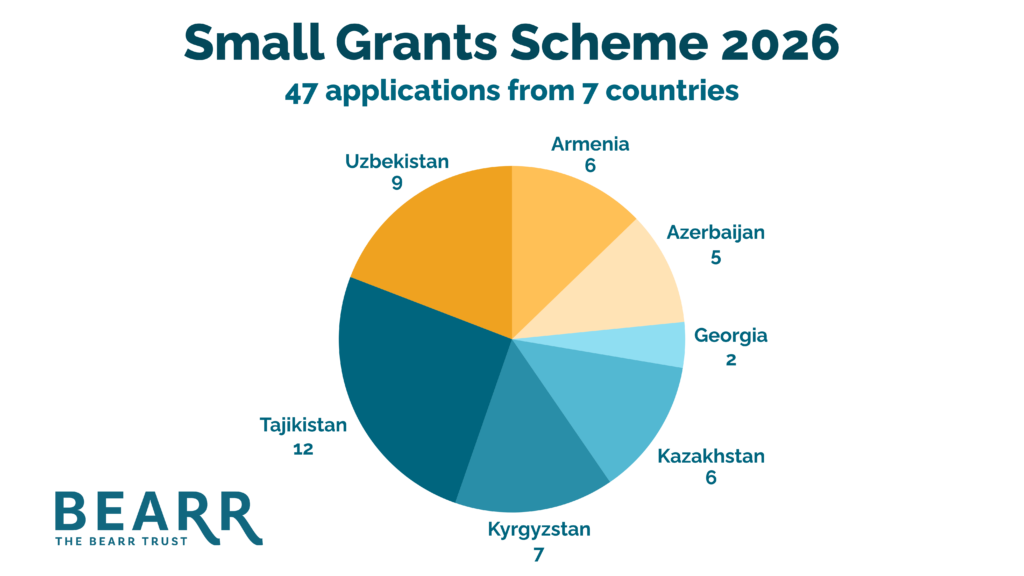
Applications for this 2026 Small Grants Scheme round closed on 13 March. We were delighted to receive 47 applications from seven countries.
Chosen projects
The Trustees have approved grants for the following eleven projects:
Armenia
- From Trauma to Empowerment: rebuilding the lives of women behind bars
Incarcerated and formerly incarcerated women will participate in a four-month psychosocial programme offering trauma-informed counselling, structured group therapy, and individual support to strengthen resilience, coping skills, and reintegration prospects.
Georgia
- Breaking Silence: women living with HIV and women who use drugs against obstetric violence
Workshops will be implemented across six countries to enhance women’s ability to recognize and respond to gender-based and obstetric violence, supported by experience sharing, social media awareness content, and dissemination of key lessons learned.
- Safer Communities for Women in Zugdidi IDP Settlements
Internally displaced women will be supported to act as community ambassadors identifying violence cases and linking survivors to services, alongside strengthening cooperation between local institutions, outreach in IDP settlements, and distribution of rights and referral information.
Kazakhstan
- Equal from the Start: a bilingual illustrated book for boys aged 6–10 on preventing violence against women and girls in Kazakhstan
A bilingual illustrated book and teacher guide on gender equality and violence prevention will be developed, piloted in schools and communities in Almaty, refined through feedback and evaluation, and published as a digital resource.
- Dauys Podcast
Violence against women with disabilities will be addressed through accessible podcasts, expert content, institutional advocacy, crisis centre accessibility audits, a “Bridge of Trust” referral system, and a permanent digital library for survivors and professionals.
Kyrgyzstan
- Know & Act: engaging youth in violence prevention
Women leaders will be trained in the “Know & Act” violence-prevention methodology, complemented by interactive school sessions on women’s rights and non-violent behaviour and public awareness activities during the 16 Days of Activism campaign.
- Safe Access Network: discreet community support for survivors of gender-based violence in Bishkek
Survivors will gain access to discreet support channels through information materials in pharmacies and beauty salons, an anonymous chatbot and website, trained community safe access points, and strengthened referral monitoring systems.
- Voices Across Generations: preventing violence against women and girls through community dialogue and empowerment
Community engagement activities will bring together older women, young women, girls, and boys in awareness sessions, education workshops, and intergenerational dialogues focused on gender equality and violence prevention, supported by volunteer training and local campaigns.
- Youth for Respect: preventing violence against women and girls through education, emotional support and youth leadership
Adolescents will benefit from interactive workshops, art therapy, and psychological support focused on respectful relationships and conflict resolution, while teachers will be trained and youth ambassadors lead peer initiatives and community awareness efforts.
Tajikistan
- Mobile support network to prevent violence against women and girls in rural communities
A mobile outreach programme will deliver psychological, reproductive health, and HIV/STI services to vulnerable rural women, combined with art therapy, follow-up support, capacity building for community activists, and partner training on identification and referral of violence cases.
Uzbekistan
- Empowering the Invisible: mobile protection and rights-based support for women with disabilities in the rural Tashkent region
Remote and isolated survivors will be reached by a mobile team of a lawyer, psychologist, and coordinator providing consultations and workshops aimed at challenging normalisation of violence and improving access to support services.


