Webinar — Voices from Ukraine: a year of BEARR’s Community Resilience Fund
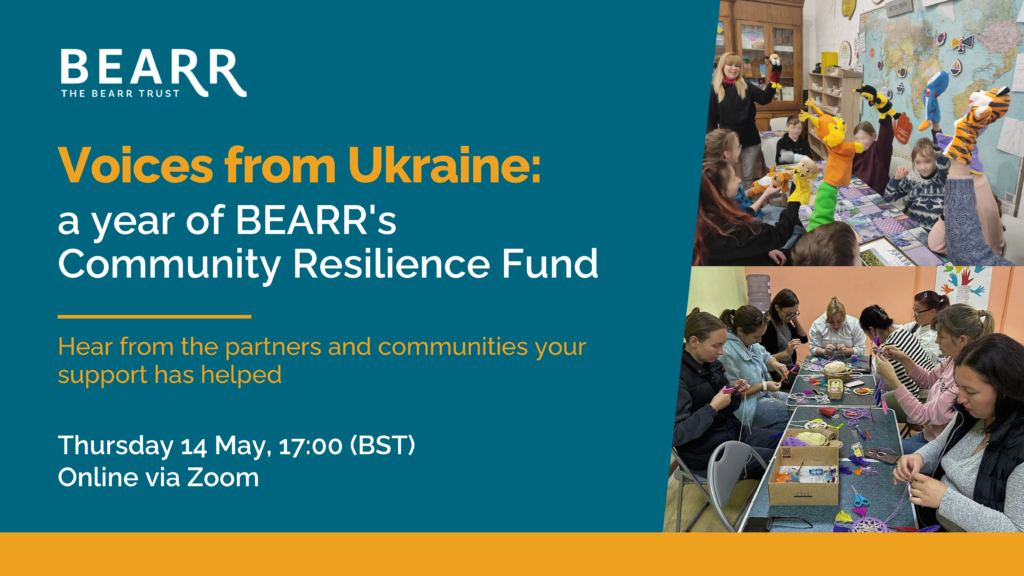
On 14 May 2026, the BEARR Trust hosted an online conversation to mark one year of the Ukraine Community Resilience Fund. Three partners joined moderator and journalist Anna Bowles to speak about their work, the communities they serve, and the realities they face. More than 30 people attended from the UK, Ukraine, and beyond.
View the recording here:
The situation on the ground
All three speakers – Ivan Vostroknutov of Kharkiv City Boxing Club, Nataliya Shmurikova of the Centre for Strategic Initiatives in Khmelnytskyi, and Sashko Protyah of NGO Freefilmers – described communities under profound and unrelenting pressure. Ivan opened by noting that in the 24 hours before the webinar, Russia had launched over 1,500 drones and hundreds of rockets across Ukraine. Drones had flown directly over his apartment building in Kharkiv that morning.
Nataliya painted a picture of rural western Ukraine transformed by displacement: villages where one in ten residents is an IDP, where entire communities of women are raising children and working the land alone, and where, in her words, there are now “no men under 65.” Sashko, whose organisation works across frontline regions in the south and east, was direct about what people in those communities need most: support in order to survive. “Most Ukrainians,” he said, “have to try to survive in the times of Russian aggression.”
Small grants, local knowledge
A recurring theme was the gap left by large international NGOs. Both Ivan and Sashko noted that international organisations tend to fund larger local partners, are often not permitted to operate near the front line, and can be slow and inflexible. By contrast, organisations like theirs – rooted in their communities, known to their neighbours – can move quickly and reach places that others cannot. Anna Bowles summarised it: “Small Ukrainian groups are often made up of people who live in those communities and are totally free to act in whatever way they think best. And they generally know best, because they are locals.”
The speakers described work ranging from seed boxes and gardening tools for displaced families, to psychosocial recovery programmes for children, to camouflage nets made by women’s collectives in frontline villages. Sashko’s organisation also supports soldiers and paramedics from rural areas who lack the social capital to fundraise effectively for their own equipment.
Burnout
When an audience member asked how the speakers were coping with years of sustained pressure, Nataliya spoke about acute burnout and PTSD among volunteers working without a break. She called for mental health support to be built into project funding as standard.
After the event, Sashko shared something he hadn’t been able to say on the call:
“Honestly, I was stuck when I heard the question about burnout. I’m just too burnt-out to talk about that.”
That remark – quoted here with his permission – says more than any prepared answer could. Ukrainian civil society volunteers are not outside the crisis: they are living it, alongside the people they support. It is a reminder that what these organisations need is not only responsive funding when they ask for it, but proactive support that anticipates the cost of keeping going.
Since its launch in May 2025, the Ukraine Community Resilience Fund has supported 25 community-based organisations across Ukraine. If you would like to support this work, please donate here.


